
Smart and Programmable Thermostats We Install
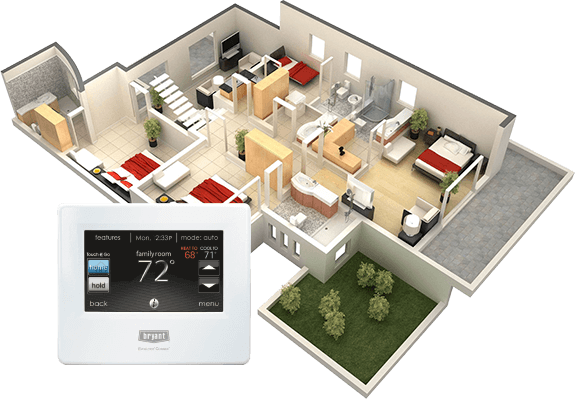
THERMOSTATS
Furnaces
Evolution® Connex™ Control
- Wifi: Available
- Zoning: Up to 8 Zones
- Humidity control: Available
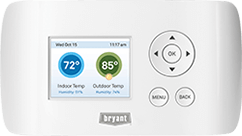
Bryant® Wi-Fi® Thermostats
- Wifi: Available
- Zoning: Zoning Panel Compatible
- Humidity control: Available
Programmable Thermostats
- Wifi: Not available
- Zoning: Up to 8 Zones
- Humidity control: Available / Not available
We Service
- Bethesda
- Chevy Chase
- Gaithersburg
- Germantown
- Kemp Mill Maryland
- Olney
- Potomac
- Rockville Maryland
- Silver Spring
- Wheaton MD
Thermostats fall into four categories: non-programmable, programmable, smart or connected, and communicating controls matched to one manufacturer's equipment. Which category you can use depends less on preference than on what sits behind the wall, since a single stage furnace, a heat pump, and a modulating system each need different capability. Shemtov Systems supplies Carrier and Bryant controls alongside conventional programmable models across Silver Spring and Montgomery County. Call 240-355-3333 to work out which type your system will accept.
Key takeaways
- Non-programmable and programmable controls run on conventional 24 volt wiring and remain sensible on simple single stage systems.
- A smart thermostat is brand agnostic; a communicating control belongs to one equipment family and cannot be swapped for a generic model.
- ENERGY STAR certification is measured as reduced equipment runtime in real homes, and the bar for cooling is higher than for heating.
- The equipment data plate, not the thermostat box, tells you how many heating and cooling stages the control has to drive.
- Humidity control and remote room sensors are the two features that most often justify their cost here.
What are the four main types of thermostat?
Non-programmable controls hold one setpoint until somebody changes it. Programmable models run a schedule, commonly 7 day, 5 plus 2, or 5 plus 1 plus 1, and are still sold for rentals and simple systems. Smart thermostats add a Wi-Fi connection, phone access, remote room sensors, and usage history. Communicating controls are a class of their own: the system's brain, exchanging data with the equipment rather than closing relay contacts one at a time.
How is a communicating control different from a smart thermostat?
The difference is how the control talks to the equipment. A smart thermostat closes contacts on a conventional terminal strip, working with most equipment that speaks the standard R, G, Y, W language. A communicating control instead runs a small data bus to the equipment, typically four wires carrying power and data. That link lets the system report faults by code, share outdoor temperature readings, and modulate capacity in fine increments. The trade off is commitment: control and equipment must come from the same family.
How do you match a thermostat to the equipment you already own?
Start at the equipment data plate, not the shelf. Identify whether you have a furnace, a heat pump, or a dual fuel pairing, then count the heating and cooling stages, because a control that sends only one heating call cannot ask a two stage furnace for its second stage; whether it reaches high output then depends on the equipment board's own staging setting. Our guide to furnace versus heat pump in Maryland covers dual fuel.
Which thermostat features actually matter in Maryland's climate?
Humidity control earns its keep here. A control that can call for dehumidification, by slowing the blower or extending a cooling cycle slightly, makes a real difference through a muggy Montgomery County July, and one that can drive a whole house humidifier keeps winter dryness in check. Remote room sensors are the other feature worth paying for, in split levels and colonials where the hallway is nothing like the bedrooms above it.
What does ENERGY STAR certification actually require?
ENERGY STAR does not certify on a claimed savings figure. Certification rests on field data from real installations, measured as reduced equipment runtime, with separate bars for the two seasons. Heating savings must reach at least 8 percent at the lower 95 percent confidence limit and 4 percent at the 20th percentile, meaning four homes in five did at least that well. Cooling must reach 10 percent and 5 percent on those same measures.
Frequently asked questions
Are smart thermostats worth the money?
It depends on what you are replacing. The households that gain most are those that previously left a manual control at one setting year round, because most of the saving comes from setbacks that actually happen. If you already run a sensible schedule, the energy case is smaller.
Do programmable thermostats still make sense?
Yes, on simple single stage systems and in homes where nobody wants an app. A programmable control captures most of the setback saving as long as the schedule is set once and left alone. Smart models pull ahead where the routine is irregular.
Will my existing thermostat work with a new system?
Often not. Adding stages, a variable speed blower, or communicating controls can put new equipment beyond what an older control can drive. If the new system is zoned, the control must also suit the zone panel, which our zoning equipment and components page explains.
Talk to Shemtov Systems
To compare thermostat options against the equipment you already own, call Shemtov Systems at 240-355-3333. Have the model numbers off the furnace or air handler and we can narrow the list first.
Homeowner guides
Straight answers to the questions we hear most from Montgomery County homeowners.